Chapter 2: What Is a Super-App?
2.1 The Simple Meaning of a Super-App
Section titled “2.1 The Simple Meaning of a Super-App”A super-app is an app that becomes more than one app.
A normal app usually does one main job. A messaging app helps you send messages. A payment app helps you pay people or businesses. A shopping app helps you buy things. A calendar app helps you manage time. Each app has its own purpose, its own account, its own interface, and often its own separate place on your phone or computer.
An International Student’s Two Super-Apps
As a Chinese international student in the United States, Keny experienced the super-app idea before he had a name for it. WeChat remained the easiest way to stay connected with family and old friends in China. Family conversations, classmate groups, voice messages, photos, red envelopes, and practical updates all arrived through the same familiar account, even when the people involved were separated by thousands of miles and several time zones.
The contrast became clearer whenever he returned to China or needed to handle a China-based task. A restaurant menu, train service, hospital registration page, store membership, bill payment, or local booking could open as a mini-program inside WeChat. There was often no need to search an app store, create another password, or learn a new payment process. In the United States, the same sequence might require separate messaging, banking, shopping, transportation, and service apps.
ChatGPT later became a second kind of super-app in his life as an international student. WeChat connected him to people and services; ChatGPT connected his intentions to digital work. He could begin with rough bilingual notes, ask for a clearer English email, organize research, revise a paper outline, inspect a spreadsheet, build a small website, or troubleshoot code without changing tools for every step. The experience was not identical to WeChat, but the feeling was familiar: one trusted starting point reduced the friction of navigating an unfamiliar environment.
This personal comparison explains the central argument of this chapter. A super-app becomes valuable not simply by containing many features, but by becoming the place where a person naturally begins. For Max, WeChat often begins a social or daily-life task, while ChatGPT increasingly begins a writing, learning, creative, or technical task.
A super-app works differently. It becomes a central place where many everyday tasks happen inside one environment. You do not leave the app every time your goal changes. You stay inside the same app and move from conversation to payment, from payment to booking, from booking to customer service, from customer service to shopping, and from shopping to a small tool built by another company.
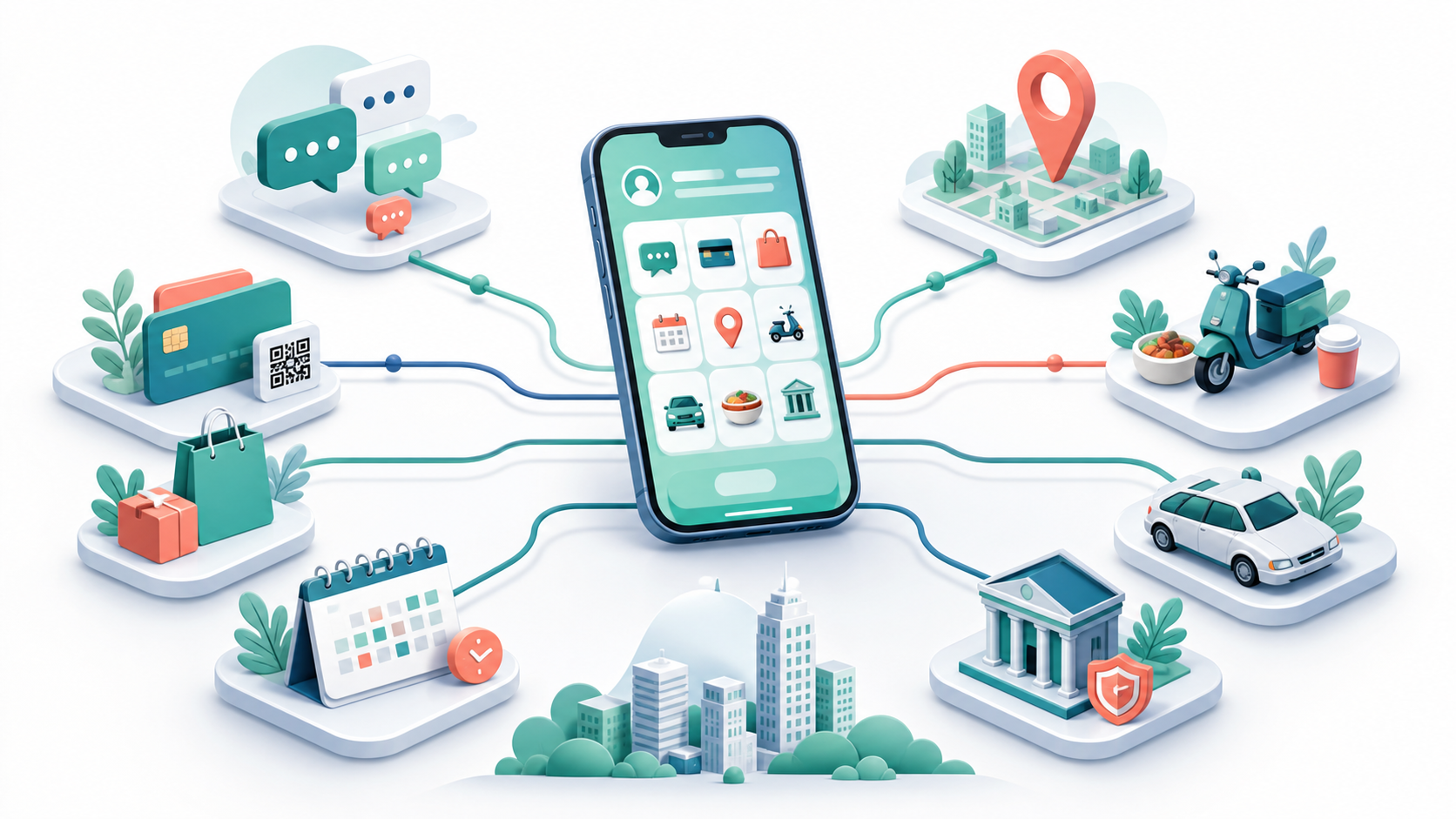
The simple meaning is this: a super-app is a digital home base. It gathers many services under one roof so users can do more of their daily life without constantly switching apps.
This idea matters because it changes the role of software. Instead of treating every task as a separate destination, a super-app treats many tasks as connected parts of one larger workflow. The user does not think, “Which app should I open now?” The user thinks, “What do I need to get done?” The super-app then provides the path.
2.2 Why WeChat Is the Best Real-World Example
Section titled “2.2 Why WeChat Is the Best Real-World Example”The best real-world example of a super-app is WeChat.
WeChat began as a messaging app in China, but it grew into something much larger. For many people, it is not only an app for chatting with friends. It is a social network, a payment tool, a shopping doorway, a service platform, a business communication channel, a way to access government and city services, and a place to use lightweight apps made by other companies.
This is why WeChat is such a useful example. It shows that a super-app is not defined only by how many features it has. Many apps add features. A true super-app becomes part of the operating system of daily life. People return to it not because they want to admire the app itself, but because so many practical activities are connected to it.
In the United States, app use is often more separated. A person might text in iMessage or WhatsApp, pay with Venmo or Cash App, shop on Amazon, order food through DoorDash, book travel through airline and hotel apps, and use separate apps for banking, maps, work chat, and social media. In China, WeChat showed another pattern: one app can become the doorway into many of those activities.
That is why WeChat is not just a successful app. It is the clearest modern example of what happens when an app becomes infrastructure.
2.3 The China Context Behind WeChat’s Rise
Section titled “2.3 The China Context Behind WeChat’s Rise”WeChat’s success was not only the result of good product design. It also depended on the environment in which it grew. China entered the mobile internet era under conditions that were very different from many Western markets, and those conditions helped a super-app become possible.
One factor was timing. WeChat grew during the rapid spread of smartphones. For many users and businesses, the phone became the main internet device before desktop internet habits were as deeply established as they were in the United States or Europe. In other words, mobile did not merely extend an older PC internet pattern. In many areas, mobile became the first truly dominant digital layer.
Another factor was the financial system. Credit card penetration and card-based consumer payment habits were not as deeply embedded as in some other countries. That created room for mobile payment to grow quickly. Instead of replacing a highly convenient card system, QR code payment could leap over parts of the older infrastructure and become the simpler everyday option.
QR codes were especially important because they were cheap. A merchant did not need expensive payment terminals or a complex technical setup. A printed code could turn a small shop, restaurant, taxi driver, street vendor, or local service provider into a digital payment receiver. This low cost helped online payment spread into offline life at enormous speed.
This helps answer a question many readers may have: why did WhatsApp not become WeChat? The answer is not simply that WhatsApp made worse product choices. Different countries had different payment systems, regulations, business models, consumer habits, app store ecosystems, and internet histories. WeChat succeeded because product design met the right market conditions at the right moment.
Max noticed this difference immediately as an international student. In China, a phone and a QR code often felt sufficient for daily purchases, including transactions with very small merchants. In the United States, payment was still convenient, but it was spread across bank cards, merchant apps, digital wallets, and person-to-person payment services. The difference was not that one country had technology and the other did not; it was that China’s mobile-payment layer was more consistently connected to the same social and service environment.
2.4 Why Payment Was the Turning Point
Section titled “2.4 Why Payment Was the Turning Point”WeChat did not become a super-app simply because it had many features. Many apps have many features. The important turning point was payment.
Lots of countries have powerful chat apps. WhatsApp has messaging. Telegram has groups and channels. LINE has payments, stickers, services, and business accounts in several markets. But WeChat became different because it connected the social graph to the flow of money. In plain English, it connected who you know with what you can pay for.
Three pieces were especially important: WeChat Pay, digital red envelopes, and QR code payment. WeChat Pay made the app useful for transactions. Red envelopes made payment feel social, playful, and familiar instead of cold or technical. QR code payment made offline commerce easy. A small shop, a restaurant, a street vendor, or a service provider could accept payment by showing or scanning a code.
Payment changed WeChat’s role. Before payment, WeChat was mainly a communication tool. After payment, it could connect online relationships with offline commercial activity. A conversation could become a purchase. A group chat could become an event. A business account could become a sales channel. A restaurant interaction could become ordering and payment. The app moved from “talking” to “doing.”
This is one of the deepest lessons of the super-app model. Features matter, but transaction power matters more. When an app controls communication and payment together, it can become a daily-life entry point rather than just a place to exchange messages.
2.5 How WeChat Combines Messaging, Payments, Shopping, and Services
Section titled “2.5 How WeChat Combines Messaging, Payments, Shopping, and Services”WeChat’s power comes from combination.
Messaging is the foundation. People use WeChat to talk with friends, family, coworkers, clients, classmates, local groups, and businesses. Because communication is already there, other activities can attach naturally to the conversation. A friend can send a payment. A business can answer a question. A group can organize an event. A customer can receive an update. The conversation becomes the starting point for action.
Payments are the core layer that turns this social foundation into infrastructure. Once payments are built into the same environment as messaging, ordinary tasks become faster. If you can talk to a seller and pay in the same place, the boundary between communication and commerce becomes smaller.
Shopping and services add another layer. Inside WeChat, users can interact with stores, brands, restaurants, delivery services, transportation services, entertainment services, and many other providers. The app becomes a doorway into the wider economy.
This is the super-app pattern in action: communication, identity, payments, services, and third-party tools all reinforce one another. Each layer makes the other layers more useful. The more people use the app to communicate, the more useful payments become. The more useful payments become, the more businesses want to be there. The more businesses build there, the more users have reasons to stay.
2.6 The Mini-Program Ecosystem: WeChat as a Platform
Section titled “2.6 The Mini-Program Ecosystem: WeChat as a Platform”WeChat’s mini-program ecosystem deserves special attention because it is one of the most distinctive parts of the super-app model.
A mini-program is a lightweight application that runs inside WeChat instead of requiring the user to download a separate full app from an app store. This turns WeChat into something more than an app. It becomes a mixture of operating system, app store, browser, payment platform, and identity layer.
For users, this means many services can be opened quickly from inside the same environment. For businesses, it means they can reach customers without convincing every customer to install a separate app. In China, many companies and service providers build a WeChat mini-program before, or instead of, building a standalone app.
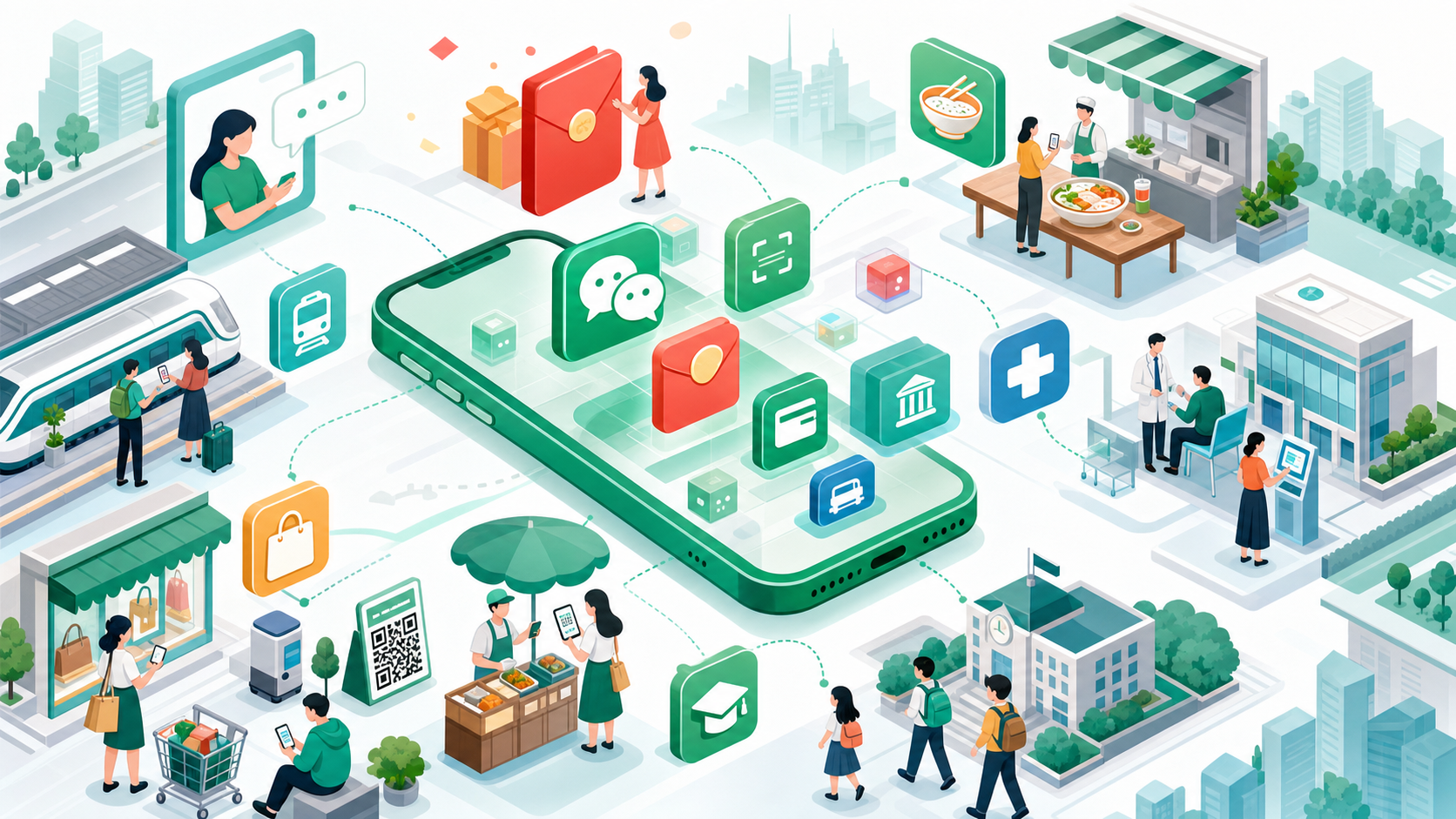
The range is broad. Food delivery, hospital registration, restaurant ordering, e-commerce, ticketing, local services, education tools, transportation services, and government services can all be handled through mini-programs. A user may scan a QR code, open a mini-program, complete the task, pay inside WeChat, and leave without ever visiting a traditional website or installing a new app.
This is the most typical expression of a super-app: the app stops being only one product and becomes an ecosystem where other products live. WeChat does not merely offer features. It gives other organizations a way to exist inside WeChat’s daily-life interface.
2.7 Why People in China Use WeChat for Everyday Life
Section titled “2.7 Why People in China Use WeChat for Everyday Life”People in China use WeChat for everyday life because it solves everyday problems in one place.
A person might use WeChat to message family in the morning, coordinate with coworkers, pay for breakfast, scan a code at a store, book a service, join a school or neighborhood group, read updates from a business, order food, transfer money to a friend, and access a mini-program without installing anything new. The exact use varies by person and region, but the larger pattern is clear: WeChat is woven into daily routines.
Convenience is one reason. When many services are connected to one familiar account and one familiar interface, small tasks take less effort. There is less downloading, less signing in, less searching, and less switching.
Network effects are another reason. A network effect means a service becomes more valuable as more people use it. If your friends, family, coworkers, customers, stores, schools, and local services are all reachable through WeChat, then WeChat becomes difficult to replace. Even if another app has a nicer feature, it may not matter if your real-world relationships and services already live somewhere else.
Trust and habit also matter. Once people learn that an app can handle many ordinary tasks, they stop seeing it as one tool among many. They start seeing it as the default place to begin.
2.8 Platform Network Effects: Why WeChat Is Hard to Challenge
Section titled “2.8 Platform Network Effects: Why WeChat Is Hard to Challenge”Network effects are another reason WeChat became so difficult to challenge. A simple network effect means a service becomes more valuable as more people use it. But WeChat’s network effects are deeper than that. They are platform network effects, with several groups reinforcing one another at the same time.
The first layer is user to user. If your family, friends, classmates, coworkers, customers, and neighborhood groups are already on WeChat, you have a strong reason to stay. A messaging app is only useful if the people you need are reachable there.
The second layer is user to merchant. The more users pay through WeChat, the more merchants want to accept WeChat Pay. The more merchants accept it, the more useful WeChat becomes for users. This loop connects social behavior with commercial behavior.
The third layer is merchant to merchant. When many businesses operate inside the same payment and service environment, adjacent businesses begin to depend on the same habits. Restaurants, delivery services, retailers, local service providers, and advertisers can all build around the expectation that customers already know how to use WeChat.
The fourth layer is user to mini-program developer. Developers build mini-programs because users are already inside WeChat. Users spend more time in WeChat because more useful mini-programs are available. This is the same basic logic that makes an app store powerful, but it is placed inside a daily communication and payment environment.
The fifth layer is developer to payment system. Once developers can rely on identity, traffic, messaging, sharing, and payment inside one platform, the cost of launching a service drops. A new service does not need to build every piece of infrastructure from scratch. It can plug into the existing WeChat ecosystem.
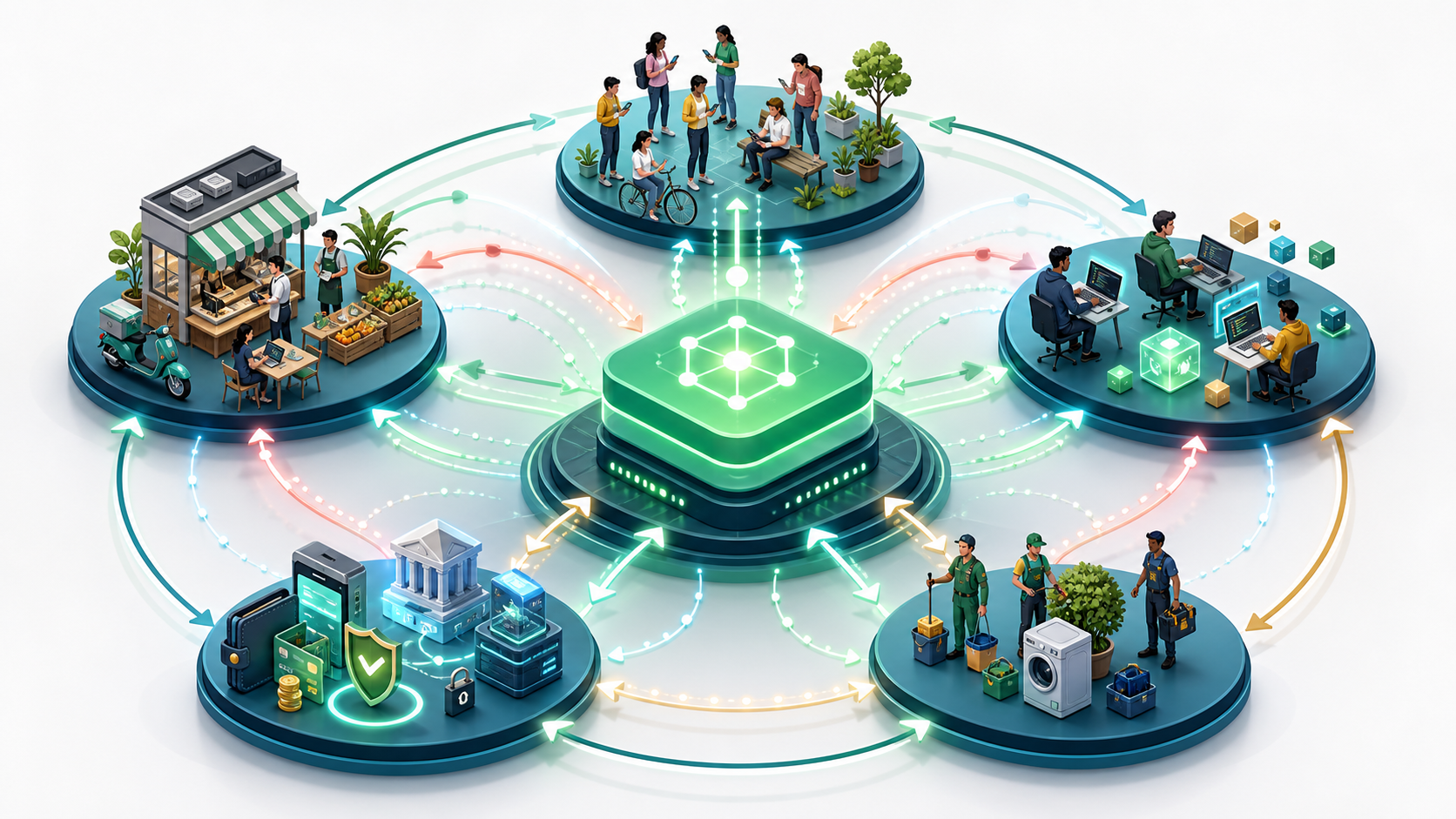
This multi-layer network effect explains why later competitors face such a hard problem. They do not only need to build a better chat app, a better wallet, or a better mini-app system. They need to move users, merchants, developers, payments, habits, and trust at the same time.
2.9 The Difference Between a Normal App and a Super-App
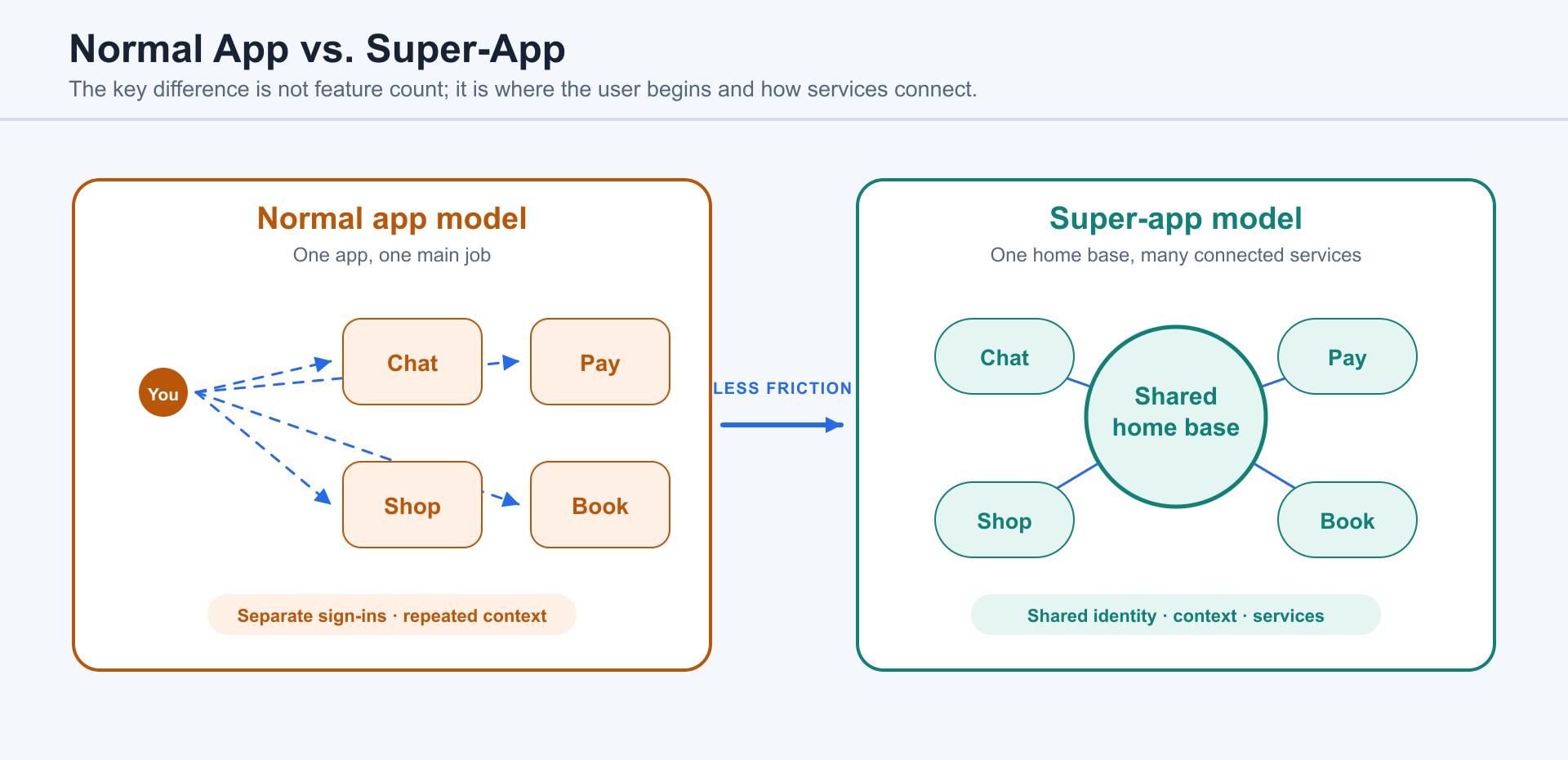
Section titled “2.9 The Difference Between a Normal App and a Super-App”The difference between a normal app and a super-app is not only size. It is role.
A normal app usually serves a specific function. You open it because you already know the kind of task you want to do. If you open a weather app, you want the weather. If you open a bank app, you want banking. If you open a map app, you want directions.
A super-app becomes a place where many kinds of tasks begin. It is less like a single tool and more like a platform. It gives users a shared account, shared interface, shared payment layer, shared communication layer, and shared ecosystem of services.
A normal app asks the user to adapt to its one purpose. A super-app adapts to many purposes.
2.10 The Costs and Risks of Super-Apps
Section titled “2.10 The Costs and Risks of Super-Apps”Super-apps are powerful, but they are not purely positive. The same centralization that makes them convenient can also create serious costs.
One risk is single-point failure. If one ordinary app breaks, one part of your life is interrupted. If a super-app breaks, many parts may be interrupted at once. If a WeChat account has a problem, the user may lose access not only to chat, but also to payment, work groups, customer contacts, service access, mini-programs, and daily routines.
Another risk is market power. When many users and businesses depend on one platform, that platform can shape the rules of access. It can influence which businesses are easy to discover, which services gain traffic, and which behaviors are rewarded or limited.
A third risk is user lock-in. The more relationships, payments, services, and records live inside one app, the harder it becomes to leave. Even if a user wants to switch, the cost may be high because the user’s social life, work life, and service access are already tied to the platform.
Privacy is also a concern. A super-app can concentrate communication data, payment data, location data, service usage, business interactions, and identity information in one environment. That concentration may make services smoother, but it also increases the importance of governance, transparency, security, and user control.
This is the price of the super-app model. It reduces friction by centralizing activity. But centralization always raises the question: what happens when too much of life depends on one gate?
2.11 How ChatGPT Fits the Super-App Idea
Section titled “2.11 How ChatGPT Fits the Super-App Idea”ChatGPT fits the AI super-app idea because it can become a central entry point for many kinds of digital work, while still relying on distinct tools, Apps, permissions, and human approval.
For the author, this comparison is grounded in daily student life. WeChat reduces the distance between him and the people and services he knows in China. ChatGPT reduces the distance between an idea and a finished digital result in the United States. One helps him maintain continuity across countries; the other helps him adapt, learn, communicate, and build across languages and professional contexts.
You can use ChatGPT to ask questions, write drafts, edit documents, explain code, build software, inspect files, summarize research, create plans, run commands, work with spreadsheets, prepare presentations, and connect ideas across different tools. Instead of opening a separate app for each small step, you can bring the goal to ChatGPT and let it help organize the work.
But ChatGPT and WeChat are different in a fundamental way. WeChat integrates people with services. ChatGPT integrates intentions with actions.
WeChat is built around the pattern: person to service. I want to buy something. I want to pay someone. I want to book an appointment. I want to order food. The app connects the user to a service provider and makes the transaction easier.
ChatGPT is built around a different pattern: intention to action. I want to finish a chapter. I want to build a small app. I want to understand this codebase. I want to plan a trip. I want to compare options, organize the result, and produce something useful.
For example, WeChat might help a user book a hotel, buy a plane ticket, and pay. ChatGPT could help at a broader level: plan the trip, compare hotels, organize a budget, generate an itinerary, draft messages, create a packing checklist, and then help the user move toward booking. WeChat is strongest at connecting services. ChatGPT is strongest at helping turn a goal into a sequence of work.
That means ChatGPT is not exactly a traditional super-app. It is closer to an AI agent platform: an intelligent layer that understands what the user wants, uses tools, and helps convert intention into completed action.

2.12 Why AI Super-Apps May Become Important
Section titled “2.12 Why AI Super-Apps May Become Important”AI super-apps may become important because modern work is fragmented.
Most people use too many tools. They write in one app, message in another, store files somewhere else, manage tasks in another system, analyze data in spreadsheets, build websites in code editors, schedule meetings in calendars, and search for information across browsers, drives, and inboxes. Each tool may be useful, but the total experience can become exhausting.
AI changes the possibility. If an AI system can understand language, use tools, remember context within a task, inspect files, and carry out steps, then the user no longer has to manually manage every transition between apps. The user can describe the outcome. The AI can help coordinate the path.
This points to a larger shift. The traditional model is: user to app to service. The super-app model is: user to super-app to service. The AI agent model is: user to AI to service.
In the future, users may not open many apps directly. They may simply state a goal: “Find me the cheapest direct flight to Tokyo next week.” An AI agent could search, compare, ask for confirmation, complete payment through approved tools, record the itinerary, and update the user’s calendar. The user expresses the intention; the AI coordinates the work.
This does not mean one AI app should control everything. That would create risks around privacy, dependency, mistakes, security, and power. A good AI super-app should still be transparent, reviewable, and controllable. The human user should remain the final authority.
But the direction is clear. People do not only want more apps. They want less friction. They want tools that understand what they are trying to do and help them finish. In that sense, the future may move beyond the super-app toward something even larger: an AI operating system for everyday work.
That is the larger promise behind ChatGPT: not one feature that does everything, but a workspace where a person can explain a goal, choose the right mode, collaborate with an intelligent assistant, and turn ideas into reviewed work.